Tiger Muskie Fishing | Musky Lures | Rods and Reels

Musky Fishing Authority - Pro Fishing Tips, Muskie Lures, Net, Rod & Reel Reviews

  • Lures
  • Reels
    • Abu Garcia
      • Ambassadeur Classic C4
      • Revo Toro Beast
    • Daiwa
      • Lexa 300
      • Lexa Type-WN
    • KastKing
      • Rover
    • Okuma
      • Komodo SS
    • PENN Reels
    • Shimano
      • Calcutta Reels
      • Corvalus
      • Tranx 300 & 400
  • Rods
    • St. Croix Musky Rods
  • Line
  • Nets
  • Tackle Boxes
  • Tips
    • Musky Fishing
    • Muskie Fishing Tips
  • Directory

How To Catch Muskie: Master The Art Of Musky Fishing Today!

July 22, 2015 by Muskie Jason Leave a Comment

Last updated on March 7th, 2023 at 11:48 pm

how to catch muskieThe true fisherman for Musky is not the guide, not the resort owner, not the feature writer, it’s you. You are the only one who is going to be able to measure your successes and failures. Half the fun in tiger muskie fishing and catching the mighty Musky is the preparation and follow through that you’ll put into each and every trip. Throughout this site, we hope to teach you how to catch muskie.

Learn How To Catch Muskie

There will be days of musky fishing when you have covered a lot of water and made a lot of casts, only to come up empty handed. Then there will be days when you will be successful when you least expect it. Of course, the best reward is when you put that cast exactly where you want it. And, on the retrieve you watch and feel that massive energy climb up the end of your fishing line all the way through your muskie rod and into your hands and wrists waiting for your instant reaction of setting the hook. While learning how to catch muskie, patience and understanding your prey will be the most successful tools you’ll have at your disposal. But you’ll also have to have skills and luck on your side.

Here is something to consider while you learn how to catch muskie. The most successful lakes, the lakes where the most Muskies are caught, generally have an average population of fish that are the same size; whereas other lakes, lakes where Musky are scarce but are still there,  those lakes have larger Muskies on average. That’s where the trophies lie. This is due to the competition for the food source. The more Muskies there are, the less food per fish, so the competition for food is high. In lakes that have fewer Muskies, the competition is less, so they eat better and grow larger.

When trying to determine a good body of water to fish for musky, start by checking the province of state’s Division of Natural Resources (DNR) website. You could then also check Facebook groups, clubs, bait shops, and local fishing forums.

How To Catch Muskie: Select the Proper Bait and Stick With It

Watch the surface of the water for activity. One of the things you will learn quickly is that if there is a Loon in the water, swimming about and actively diving below the surface, then you can rest assured that there will be no fish in that area. They dive below the surface, look around, and then come back up. This disturbs the larger game fish and they quickly vacate the area. You will notice Loon chicks traveling on their parents back. This is because they are great bait for the huge fish.muskie bait

Don’t keep changing baits! If you have confidence in what you’ve chosen to use, and have chosen the muskie lures by following our steps as to sky conditions, water conditions, etc., you be able to keep with it, tossing that lure for longer periods of time. Some anglers may make ten thousand casts before they get their first muskie strike. When they do hook onto a tiger Musky it is not uncommon to lose a fish because the line breaks or the knot releases on the lure or swivel, especially when first learning how to catch muskie.

>> Check Out Some Of Our Favorite Muskie Lures <<

How To Catch Muskie: Deep Water And Steel Leaders

Don’t be afraid to try tiger muskie fishing in deeper water. You don’t have to constantly fish by casting up against the shore line. Yes it is true that Musky will cruise the shore line looking for a meal, but if they are feeding on perch as they do in Lake St. Clair in Ontario Canada, they will also search and feed in the perch schools. Try musky fishing in fourteen to sixteen feet of water and use crank baits that looks like a perch. The crank bait will usually dive down about six feet or so. If the lake you are fishing in allows trolling, then these baits are ideal to troll with.

Use a wire steel leader when muskie fishing. If you are going to use smaller bait lures, like crank baits, and the tiger Musky is of any size, when the fish strikes he will most likely devour the entire lure. Without that leader, your line will surely be severed. And no one wants to lose that trophy fish, especially if it is your first one and you are just learning how to catch muskie. If you are going to have to lose a fish, make sure it was because the fish was smarter than you and not because of a mistake you made.

How To Catch Muskie: Proper Drag Setting

muskie reelOne of the things we have not mentioned here is line drag. Every muskie fishing reel has a drag setting. Fishing line is sold in tensile strength, meaning, how many pounds of force does it take to break the line. The drag on a fishing reel is designed to provide resistance against being pulled off of the reel. The fish will feel this force and will apply the opposite force to that resistance. The musky thinks that the food in his mouth is trying to escape. It is also designed to make the fish tired or take the fight out of him. Fish exert a tremendous amount of energy when they have been hooked. So much so that if you think of a Muskies anatomy, they have a huge mouth, and very large muscles along each side of its back running from the back of the head all away down to the end of his tail. The larger the fish, the stronger that muscle is.

So how much drag should we apply? The recommended amount of drag is 25% of the lines breaking strength. A good way to measure that is by using a fish scale and the following formula where x is the line strength and y is 25% and the drags setting is Z. Here is the formula to be used: X/Y= Z. So if the line is a twenty pound test line then 25% of the line strength is five pounds. The drag should be set to five pounds. To do this properly, tie one end of the line to the end of a fish scale, and attach the other end of the fish scale to a stationary object. Once force is applied, adjust the drag setting so that no line is allowed to come off the spool until the scale reads five pounds.

Now that this is completed you should never have a line break because of the drag. As the muskie fights against the line and the flexibility of the rod, when the five pounds of force limit is met, then line will be let out. Now keep in mind that if you are using a bait casting reel, as opposed to a spinning reel, that there are two drag settings. One is for when you are fighting the fish, and the other one is when you are casting. What this second drag is for, is to apply tension to the reel spool when casting in order to control the free spooling, and therefore limiting any kind of backlash and line tangling on a reel. I am sure we have all done that before. The more practice you have with casting and getting to know your equipment, the better chances of success you will have.

>> Click Here To See Our Recommended Muskie Reels <<

How To Catch Muskie: Always Be Ready

You should also always be ready with a good quality musky net, like one of the Frabill musky nets for sale. Also, it’s important to keep your musky lures organized is the best musky tackle box for sale.

The last thing to remember when learning how to catch muskie is to always be ready! It is always when you least expect it that a Musky will hit your lure. Good luck!!!

Remember, our main goal here at TigerMuskie.net is help you to learn how to catch muskie. While we do have a lot of experience in this area, we admit that we don’t know it all. If you have any tips, tricks, or advice to share on how to catch muskie, feel free to contact us.

Filed Under: Uncategorized

Sharing is caring    Share +1 Tweet Share Share

Wisconsin Puts Muskie First

July 17, 2015 by Muskie Jason Leave a Comment

Last updated on August 25th, 2018 at 02:13 pm

The muskellunge (aka musky or muskie) is believed by many to be one of Wisconsin’s most unique and important trophies. In 1955, the State Legislature proclaimed the musky to be the official State Fish of Wisconsin, due to it being so highly valued. Thanks to WI putting the muskie first, Wisconsin has the most musky world records than anywhere else. Taken from the Chippewa Flowage, the current state and world record muskie is an astonishing 69 pounds and 11 ounce musky, according to the WI DNR.

Putting Muskie First

Nearly 50 years after fishermen pulled the final of 4 world-record fish from Hayward, WI area lakes, huge monster musky are once again on the prowl in Wisconsin waters. This is due to Wisconsin’s efforts of putting the muskie first.

Fresh Water Fishing Hall of Fame and Museum - Hayward, WI

Fresh Water Fishing Hall of Fame and Museum – Hayward, WI

A great catch-and-release ethic among anglers, restrictive size limits, and a state-sponsored hatchery system have combined to rebuild Wisconsin musky populations that faced near collapse due to 30 years of over fishing after those world-record muskie catches in the 1950s. Things have really started to move in a positive direction since folks began putting tiger muskie fishing first.

Wisconsin has done an excellent job of rebuilding the musky population to trophy quality fish. 30 or so years ago, a 40″ musky in Wisconsin was nearly nonexistent. As recent as 10-12 years ago, 50″ musky in Wisconsin were exceptionally rare.

Since putting muskie first, Wisconsin has not only broken both of those size barriers, it can be argued that they have smashed them. The next decade looks promising for more world-class Wisconsin muskies.

Muskies, which are commonly referred to as the fish of 10,000 casts, are today actually being caught in Wisconsin waters on average in about only 3,000 casts. According to the WI DNR, each year for the past 13 years fishermen have caught an average of 29 muskies larger than 48″ and 9 musky larger than 50″ from Wisconsin lakes and rivers. These are the true measures of Wisconsin’s efforts to put muskie first.

Check out this near world record Tiger Musky (52″) caught in Vilas County, Wisconsin in August 2014.

The number of musky hunters has grown significantly to an estimated 360,000 fishermen, about 3 times the number from the late 1950s. Thanks to mutual respect among muskie anglers and respect for this great fish, nearly 98% of the muskies that are caught are being released so that they can grow bigger and live to fight another day. It’s great to see the fishermen also put the tiger muskie first.

This change in conditions, which has exceeded even the most optimistic of expectations, is leading to an evolution within Wisconsin’s approach to muskie stocking. Wildlife biologists expect a change in the public’s perception of musky stocking will also transpire.

Many don’t realize that muskie stocking is a relatively expensive, intensive process. It costs about $70 for each stocked musky fingerling that will survive for at least 18 months in the wild. So, the next time that you purchase your Wisconsin fishing license, know that your dollars are also contributing to put muskie first.

Wisconsin Fisheries Put Muskies First

In the late 1970’s, the growing belief that muskie populations were decreasing due to over fishing and poor spawning habitat inspired WI state fisheries officials to take action. Official’s research indicated that by the year 1990 increasing numbers of musky fishermen and a growing muskie harvest would possibly exceed the levels required to sustain the fishery. Fishing resource managers began a strategic process to short-circuit the possibility of that happening.

The newly created muskie management plan outlined for more restrictive harvest regulations which included increasing the 30″ minimum size limit across the state, increasing and improving data collection, protecting musky spawning habitat, and encouraging voluntary muskie catch-and-release. An increase in musky stocking was a key focal point.

muskies first

Wisconsin group releasing Musky Fingerlings

The research showed demand for muskies increasing and supply decreasing. Officials felt that the best way to address the issue was to establish a fairly extensive musky stocking program.

In 1985, the musky hatchery system produced some 200,000 fish for stocking. The general rule at the time was to stock musky lakes at twice the annual rate of harvest. Musky fisheries employees assumed that the harvest rate to be 1 musky per acre, because at the time they didn’t have great information on the harvest. Most Wisconsin lakes were being stocked at 2 muskies per acre, regardless of if the lake had it’s own naturally reproducing muskies first.

Officials now know that the musky stocking rate used then was very high given present conditions. Creel surveys showed that the musky harvest is a lot less – only .02 muskies per acre, or 2 muskies per 100 acres now.

The muskies first stocking formula did not anticipate the rising popularity of catch-and-release musky fishing, nor the implications that it would have on reducing the musky harvest. Non-profit groups encouraged anglers to ‘let the  muskies go’ – and fishermen did.

Early on in the 1980s, the expected harvest from 356 Class A Wisconsin lakes, or “trophy waters” as some call them, was 38,300 muskies statewide. By the year 1990, that total had decreased to an estimated 8,540 muskies, and by the year 2001, a paltry 1,980 muskies were actually kept.

This was a huge shift in the way anglers viewed the fish. Fishermen began to put muskies first, as well.

DNR officials and biologists, including some who had been active participants in fisheries work since the 1970s, began seeing the harvest declines brought on by the great catch-and-release ethic. Creel and population surveys verified the new trend. A lot of data began to come in as the DNR ramped up it’s sampling programs in the mid-1980s in order to help set Native American tribal spearing quotas for muskie and other fish like walleye.

During the past 20 years, catch-and-release has been rolling among the musky faithful. Since they began raising muskies, the hatcheries have been putting out a good quality product. The muskies were big, and their survival rates were improving.

The research and surveys showed that increasing the minimum size limits of musky helped to rebuild the populations. In 1984, the statewide musky size limit went from 30 to 34 inches.

Putting Musky First – A Look At The Numbers

In 1997, much of the research findings were beginning to come together when the LAB, or Legislative Audit Bureau, reviewed the Wisconsin DNR’s musky propagation program. The Legislative Audit Bureau concluded that the DNR’s system was not sufficient to meet the increasing demands for Wisconsin muskie fishing. In response to this, the DNR fisheries scientists recommended setting up a management framework to help protect and preserve the genetic integrity of native Wisconsin fish, and to also make the stocking of muskie and other species of fish more effective and less expensive.

Watch as the Hayward Lakes Chapter of Muskies Inc. stocked 1,300 tiger muskies averaging 10 to 12 inches long in Round Lake.

The DNR has since learned that stocking fewer muskies first, but larger fish has been proven to be much more economical than stocking a lot of smaller fish. Roughly about .004 percent of tiger muskie fry stocked soon after hatching in the spring would survive to fall season, and roughly about 4% of those that did survive would make it to the following year. Consequently, approximately 588,200 fry would be required to be stocked to end up with one surviving musky, and have a cost of nearly $800 per fish, according to numbers from the work done by UW – Stevens Point and DNR research teams. Cost and survival for stocking musky first as 10″-12″ long fingerlings only requires 25 muskies to yield a single surviving musky and a rough cost of about $70.75 per each musky.

Each of Wisconsin’s 220 stocked muskie waters has been assigned to it’s own specific stocking practice for a period of 10 years based on its natural reproductive status. Biologists and scientists will monitor and assess the musky first fisheries using continued surveys.

Officials feel that the worst-case scenario is fishermen will have slightly lower numbers of muskies, but larger muskies in Wisconsin waters. On the other hand, the best-case scenario would be that they will be able to discontinue stocking some lakes altogether. This, in fact, would be great news and a true sign of success with putting musky first. This would mean that something truly great is happening in Wisconsin musky lakes.

If you’re ready to get out there and put muskie first, check out our muskie rod reviews, best musky reel recommendations, and take the best musky net with you before you go.

Filed Under: Uncategorized

Sharing is caring    Share +1 Tweet Share Share

Reel in the Big One: Essential Musky Tackle for Your Next Fishing Trip

December 11, 2014 by Muskie Jason Leave a Comment

Last updated on March 7th, 2023 at 11:53 pm

In this article we’re going to help you select the proper Musky tackle for Musky fishing. As you are aware you’ll need a specific musky rod, musky reel, line, leader, and musky lures. So let’s take a look at the rod itself first.

Musky Rod

When talking about musky tackle, we most certainly need to discuss the muskie rod. Most fishing rods for everyday use are anywhere between 6 to 7 feet in length. They usually have five or six “line guides” that are affixed to the shaft. The handle itself might have many different handle styles. One might be where the reel is center mounted by twist rings and cork handles, where others might be a simple handle with an index finger hook for holding the rod while casting or reeling. The guides on a spinning rod will be small at the tip of the rod, and then get larger as the guides get closer to the handle. A Musky rod is often shorter, at about five and a half feet long, and a much stiffer rod. Because of the power of the fish, the stiffness adds to help provide resistance when the fish is fighting the line. Because the line of a level wind reel (bait casting reel) is peeled off of the spool by the weight of the musky lures as they are cast out, the guide rings are not as large at the handle end as they are with a spinning rod.

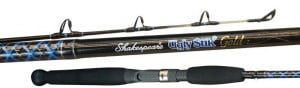
So if you are using a spinning reel, you’ll need one type of rod, and if you are using a bait casting reel, you’ll need a rod designed for that application. A good example of a widely used bait casting rod for everyday fishing is called the “Ugly Stick®” made by Shakespeare. They come in many different models for both bait casting and spinning reel applications. However, we recommend when using bait casting reels that you consider the Shakespeare Ugly Stick® either model USCA561M or the USCA562M. These two models will accept muskie lures adequately up to musky tackle5/8 of an ounce. Which is great for smaller crank bait type lures as we talked about in “How to Catch Muskie” before. The difference between the two is the handle style. But they are both medium action and 5.6 foot musky rods that are ideally suited for Musky fishing, and are reasonably priced.

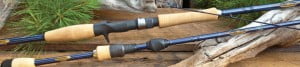
Another tiger musky rod that is excellent for Musky fishing is from the St. Croix fishing rod company in St. Croix, Wisconsin. These rods are very high end rods and without a doubt some of the best muskie rods for sale. They have many different models to choose from. When you buy one of these rods to add to your musky tackle you have many handle styles to choose from. They also make a specific model for Musky fishing called the Legend Tournament® Musky Rod. We can’t say enough good things about this musky rod. It should be a part of every musky hunter’s musky tackle. This rod is much longer at six foot nine inches and is for jerk bait fishing. Those muskie lures can weigh as much as three to eight ounces. The extra length of this rod allows those musky lures to be “whipped” to their target destination.musky rod

They will also accommodate fishing line between fifty to eighty pound line test strength. These are just a few of the musky rod choices that are out there, as there are many more. You will have to shop around and see what best fits your style, comfort, and your budget. It’s a wise idea to have a couple of the different types of muskie rods included in your musky tackle. Check out the top 3 Best St. Croix Musky Rods For Sale.

Click Here For A Great Selection Of Top Musky Rods

Musky Reels

musky reelsOf utmost importance is using high quality musky reels. In order to ensure long, problem free use, you want to be sure to select a premium muskie reel such as the Shimano Calcutta D Series.

Nothing can ruin your fishing experience more than a bad, low quality musky reel. Low quality reels tend to break easily, are not able to withstand the vigorous wear and tear of musky fishing, and have a tendency to lead to knotted fishing line.

While they can be expensive, the good musky reels are worth their higher price. They tend to function smoothly, can last a lifetime with proper care, and lend themselves to trouble free muskie fishing. Check out our Top 5 Musky Reels that we highly recommend for all muskie fishermen. No matter which you choose, you can’t go wrong with a Shimano Calcutta reel.

Musky Net

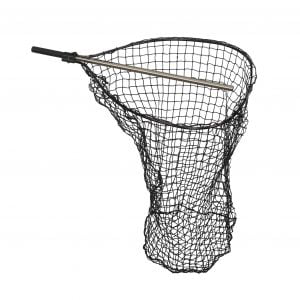
It is vitally important that you invest in a good, high quality musky net. You want a net that is sturdy, durable, and will do minimal damage to the musky. Some nets will entagle either your lure and/or the fish, and those cheap musky nets should be avoided.muskie landing nets

Just like a solid musky reel, a good muskie net can be expensive. However, this piece of your musky tackle should last you a lifetime with proper use and care. A Beckman, Frabill, or StowMaster musky landing net are all great choices.

Muskie Fishing Line

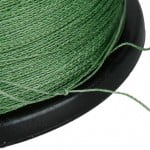
Braided fishing lineFishing line choice is another thing we will look at in regards to musky tackle. Should you use monofilament, braided, wire or something else? Each fishing line that you decide to implement as part of your musky tackle has different positive and negative characteristics. Deciding which musky fishing line to use depends mainly on which reel you are using. Not all musky reels were designed for using braided line, for example, and their winding mechanisms are not ‘braided line friendly’. Again, this depends 100% on the chosen reel. Some spinning reels do great with braided line.

Some of the benefits of braided fishing line include: longer casting, more fishing line capacity, increased sensitivity, and less line stretch. When using a braided line, however, you need to be aware of potential chafing against your fingers. There are ways to prevent this, however.

You may be concerned that the Musky will see the line. However, the fish will not be concentrating on the line. He’ll be concentrating on the musky bait you put in front of him, always thinking that if he does not go after it he’ll certainly miss a meal.

If you choose to use monofilament line in your muskie tackle, you will have some advantages. Monofilament line also comes in different colors of choice. But when that line hits the water, while you are retrieving it, it becomes more transparent than a braided line. Monofilament lines also stretch. This is especially important if you are dealing with any kind of reel back lash. Ultra Violet (UV) rays from the sun can affect the longevity of your line. The UV rays can make the line brittle, it can make the line less resistant to abrasion, and can cause it to break with much less force than what it was designed for. This is true for all types of material used in the manufacture of fishing line.

Fluorocarbon lineA third kind of fishing line known as PDVF, or Polyvinylidene Fluoride, or more commonly known as Fluorocarbon line, is one of the new modern man-made filaments used in fishing line today. This fishing line is very popular because of its refractive index, i.e. being less visible in the water. However, much like most monofilament lines it stretches when put under a load. This makes the action between man and fish less one on one. Meaning when an angler sets the hook, the fishing line stretches due to the force and the action felt by the angler has an ever so slight delay. Because of that the industry has come up with a completely new fishing line known as a “Superline”, which is a co-filament and thermally fused line. This new construction and material will allow the line diameter to be much smaller, reduces line stretch and provide great strength.

Regardless of which muskie fishing line you choose, be sure to keep a good amount of spare line in your musky tackle box.

>> Check Out Our Top Recommended Muskie Fishing Line <<

Leader

It is highly recommended that you use a leader between the fishing line and musky lures. There are many different types of leaders for you to consider. They could be Dacron, Titanium, Stainless Steel, coated wire, or many other materials and diameters. Leaders are also rated by tensile strength. The smaller diameter of a straight wire leader, the more likely you will be dealing with kinks and twists. The wire leaders that are braided will less likely have this problem as they are very thin pieces of wire, meaning individually they are more flexible, and when they are braided together they provide added strength and flexibility. Some of these braided leaders come with a protective plastic coating, while others do not. They may come in different lengths pre made with a snap swivel at one end and a loop at the other for affixing your line. They also come on rolls where you will have the ability to make your own leader in varying lengths according to personal choice. A good length for a leader is somewhere between nine and twelve inches long. Everyone should have multiple leader choices as part of their muskie tackle.

A Proper Knot

This now brings us to the subject of fishing knots. While not technically musky tackle, it is important that you learn how to tie the correct fishing knots to affix all of your connections to the line. This means the swivels, leaders, musky lures, hooks etc. There are many different thoughts on what knot is the right knot to tie on a line. For expediency here we will talk about the few that you need to get started. Over time you will search and explore different concepts and chose your personal favorite fishing knot.

The first one is the Snell knot. This fishing knot is used to tie a line directly to a hook. It is especially a good choice because it does not have a tail and it is fixed in such a fashion that it keeps the hook straight in line with the fishing line it is tied too. It is not meant to be tied to a lure, leader, or swivel. For that type of knot you should use the Improved Clinch Knot.

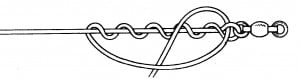
We are not recommending the simple Clinch Knot here because you are fishing for very large fish, like Tiger Muskie. The simple clinch knot has been known to slip and become undone, and you do not need that when you hook into one of these monster musky. One of the advantages of the Improved Clinch knot is that as pressure is applied it tightens itself around itself. This ensures that it will not pull free.improved clinch knot

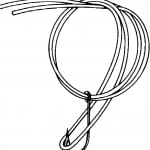
And last, but certainly not least, is the Palomar Knot. This fishing knot is a combination of the Snell Knot and the Clinch knot in that when it is tied correctly it will keep the line straight in line with the device it is being tied too.fishing knot

Follow these tips and suggestions for your musky tackle and you’ll certainly improve your chances of catching that next trophy Tiger Musky. Be sure to also check out this video for more tips on selecting the best musky tackle.

Now that you’ve got all of this great tackle, it’s time to check out the best musky tackle box reviews.

Filed Under: Uncategorized

Sharing is caring    Share +1 Tweet Share Share
« Previous Page

About Us

Hi! I’m Muskie Jason. My team and I are passionate about musky fishing and love sharing everything we know and learn about the sport. We have decades of combined musky fishing experience between us. TigerMuskie.net is the ultimate resource for learning everything about fishing for muskies.

musky fly fishing complete guide

Master the Art of Musky Fly Fishing with Our Expert Guide and Tips!

Welcome to our complete guide on musky fly fishing. If you are a traditional musky … READ ARTICLE

KastKing Rover Round Baitcasting Reel Review

KastKing Rover Round Baitcasting Reel Review: The Best Cheap Musky Reel For Beginners And Novices

If you are new to muskie fishing and shopping for musky gear, you may have some … READ ARTICLE

Musky Gear

Musky Reels

Musky Rods

Musky Lures

Musky Line

Musky Nets

Musky Tackle Boxes

Popular Articles

Muskie Reel Buying Guide

Best Muskie Rod & Reel Combos


Disclaimer: TigerMuskie.net provides lists of the best musky fishing products for anglers who quickly want to know what to get. When readers choose to buy our independently chosen editorial picks, we earn affiliate commissions that support our work. Learn more About us and how to support our work.

As an Amazon Associate I earn from qualifying purchases.

Sign Up Now For Expert Muskie Fishing Tips & Great Deals On Musky Gear

Archives

About Us

Contact Us

Privacy Policy

Terms of Service

Follow Us

Return To Top

© Copyright 2026 TigerMuskie.net · All Rights Reserved · And Our Sitemap · All Logos & Trademark Belongs To Their Respective Owners·